Wise Digital
Building or redesigning a custom e-commerce website: why technical architecture makes the difference to your sales
Published 19 November 2026
In today's online retail, the look of a store is no longer enough to guarantee its profitability. With acquisition costs on Meta Ads and Google Ads rising steadily, a brand's profitability depends on one decisive variable: its ability to turn every qualified visitor into a buyer without the slightest friction.
Yet many D2C (direct-to-consumer) and premium brands see their commercial performance plateau. The cause rarely lies in the appeal of their product offer, but in the structural limits of their platform: slow mobile loading times, stacks of conflicting third-party apps and a generic purchase journey.
Choosing a custom e-commerce website — whether for a launch or a complete redesign — is not a graphic whim. It means deploying a proprietary technical infrastructure tailored to maximise speed, brand identity and conversion rate.
1. Web performance as a profitability lever: the 2-second rule
On mobile, every extra second spent loading a product page causes a measurable drop in conversion rate. Shoppers no longer wait; at the slightest slowdown, they return to their original feed.
Core Web Vitals at the heart of the shopping experience
Google now assesses the quality of the user experience through Core Web Vitals, metrics that have become inseparable from commercial performance:
- LCP (Largest Contentful Paint): how quickly the main product visual appears. On a custom store, this time is kept under 1.5 seconds through adaptive media compression (WebP/AVIF formats) and caching on distributed servers (CDN).
- INP (Interaction to Next Paint): the immediate responsiveness of the interface on a click (choosing a size, opening the slide-out cart). No blocking script should freeze the buyer’s screen.
- CLS (Cumulative Layout Shift): the visual stability of the page. Elements jumping as a customer review or banner loads create frustration and cause mis-clicks at the moment of payment.
By removing the superfluous code inherited from generic templates, custom development ensures ultra-smooth execution — essential to make your advertising campaigns pay off.
2. Escaping sameness: the impact of proprietary design
Visual standardisation is one of the costliest traps for a high-value brand. When hundreds of stores share the same grids, the same system fonts and the same cart drawers, consumers perceive the product as ordinary and become price-sensitive.
Visual authority justifies price positioning
A custom-designed e-commerce website lets you stage the brand’s world without the rigid constraints of a pre-made template:
- Controlled typography and contrast: distinctive fonts optimised to cause no rendering shift on load.
- Immersive showcasing of materials: high-definition product zoom and seamless runway or workshop videos without affecting navigation smoothness.
- Navigation adapted to the buying journey: contextual filters designed around your sector’s purchasing logic (materials, collections, occasions), not an imposed pattern.
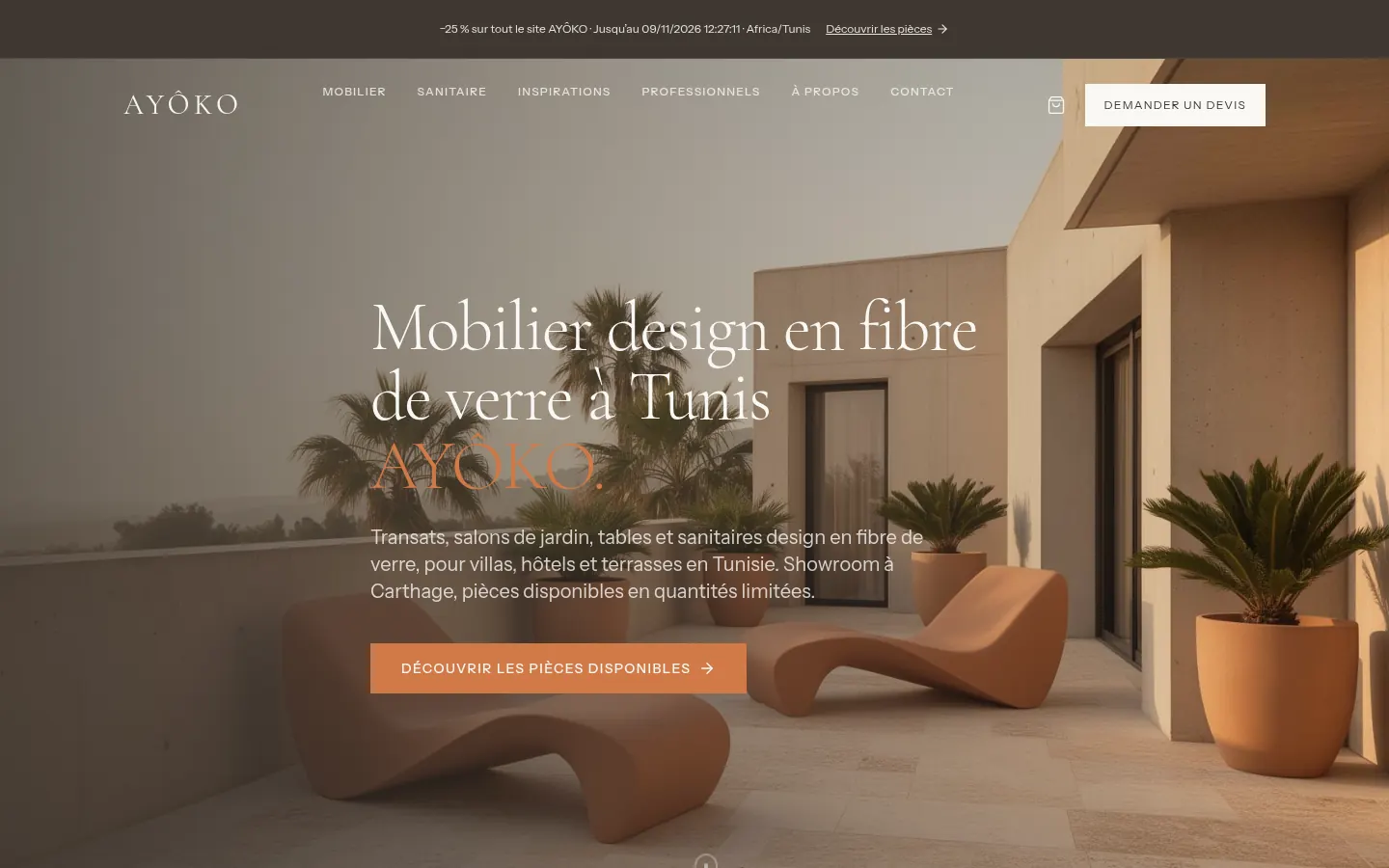
This is the graphic and technical standard we apply to demanding worlds, such as the refined wardrobe of AYÔKO or the fine-jewellery showcase of FIANKA, where every interaction must reflect the house’s level of excellence.

3. The modern custom approach: from proprietary theme to headless architecture
Going custom does not mean needlessly reinventing the technical wheel or giving up the security of a proven back office. For a growing brand, custom e-commerce today rests on two complementary approaches:
A. The proprietary theme (on Shopify or equivalent)
You keep the reliability of the back office, inventory management and secure payment gateway, but the visual interface is built from scratch in proprietary code. Benefit: no superfluous display apps slowing the store down. You get an exclusive design, a smooth purchase journey and full autonomy to manage your products day to day.
B. Headless (decoupled) architecture
For brands handling high traffic or very advanced interaction requirements, the front end (the screen your customers see) is fully separated from the database. Benefit: near-instant loading (navigation without page reloads), stronger security and total creative freedom, while your order engine (Shopify API, ERP, CRM) stays connected behind the scenes.
| Proprietary theme | Headless architecture | |
|---|---|---|
| Back office | Shopify or equivalent, retained | Order engine connected behind the scenes (Shopify API, ERP, CRM) |
| Interface | Built from scratch in proprietary code | Front end fully separated from the database |
| Strengths | No superfluous display apps, day-to-day autonomy | Navigation without page reloads, stronger security, total creative freedom |
| Best for | Growing brands | High traffic or highly advanced interactions |
4. A successful e-commerce redesign: 4 steps to a risk-free transition
For a brand already generating sales volume, redesigning its online store is a pivotal step. The challenge is twofold: increase conversion while carefully protecting its organic search history. A methodical redesign unfolds in four stages:
- Strategic scoping and friction analysis: reviewing navigation data (heatmaps, cart abandonment) to identify exactly where the current site loses sales.
- Exclusive art direction in Figma: designing desktop and mobile mock-ups, prototyping micro-interactions and approving every screen before any development.
- Clean, lightweight development: building the interface without piling up external dependencies, with rigorous testing across browsers and smartphones.
- SEO migration plan and acceptance testing: a methodical 301 redirect plan to preserve existing organic traffic, tag checks and a secure switchover without service interruption.
5. Going custom: taking your next growth step
Investing in a custom store becomes essential when:
- Your customer acquisition cost is rising and requires a better conversion rate to protect your margins.
- Your brand image has grown faster than your technical tools.
- Your current site suffers from chronic mobile slowdowns caused by stacked apps.
At WiseProjects, we design digital interfaces built as genuine sales tools: fast, understated, distinctive and technically rigorous.